PIXNET Logo登入

The Beauty of Taiwan

跳到主文

部落格全站分類:休閒旅遊

  • 相簿
  • 部落格
  • 留言
  • 名片
  • 2月 18 週六 201223:58
  • 香水

         香水一詞的起源來自於拉丁文 perfumus '經由煙燻',據說是源自埃及宗教施行的煙燻儀式。         製作香氛的牧師們認為,藉由吸入這些散發出來的味道,這樣會更加接近神。但將香水視為通往神靈世界之門的習俗,並未持續很長時間。香水卻演變成日常生活的一部分,是愉快的同義詞,也是代表純潔的象徵。
         一般說來,香水以各種特性濃度之萃取液、酒精與水,依不同比例成分混合,就香水的濃度含量主要有5個等級,區分如下:
Perfume 香精
         是香水中的貴族,香味持續力約7-9小時以上,高濃度的萃取液,容量小7.5或15ml的包裝,價格昂貴較少見。
Esprit de Parfum / Eau de Parfum香水/ 淡香精(簡稱E.D.P)
         香氣持久,價格屬中等價位,持續力約5小時左右,廣泛使用,較大眾化,所以各種類中才以此為香水統稱,而非香精。
Eau de Toilette 淡香水/ (簡稱E.D.T)
         香味比較淡,最常見價格較便宜,不過持續力差,大約只有3-4小時,多使用於沐浴之後。從這個等級開始才有較多的男性香水。
Eau de Cologen 古龍水
         持續時間約為 1-2小時,萃取液濃度較低的香水,價格最便宜,是男性香水的一般等級,至於女性香水在這個階段已經很少見了。
Eau Fraiche 清香水
         萃取液含量非常低,約只有1-2%,應已不被歸在香水範圍內,上市的體香劑、鬍後水沐浴乳都屬於這等級,香味持續力非常的短。
~ data from Yahoo!奇摩知識
(繼續閱讀...)
文章標籤

s8626460 發表在 痞客邦 留言(0) 人氣(45)

  • 個人分類:Egypt
▲top
  • 1月 11 週三 201221:49
  • 吉薩金字塔群

         吉薩金字塔群是位在埃及開羅郊區吉薩高原的陵墓群。         吉薩金字塔群於西元1979年列入聯合國教科文組織的世界遺產,並在西元2007年7月7日獲選為世界新七大奇蹟中的榮譽奇蹟。
         陵墓群建於埃及第四王朝,主要由三個金字塔組成,而當中最大是胡夫金字塔,同時也是古代世界七大奇蹟中最古老及唯一尚存的建築物,現在旁邊還設立太陽船博物館;次大的是哈夫拉金字塔;最小的是孟卡拉金字塔。此外,在這三個主要金字塔旁有著名的獅身人面像和3座屬於皇后的小型金字塔。
         吉薩金字塔群是聯合國教科文組織世界遺產孟菲斯及其墓地金字塔的一部分。
~ data from Wiki
(繼續閱讀...)
文章標籤

s8626460 發表在 痞客邦 留言(0) 人氣(66)

  • 個人分類:Egypt
▲top
  • 12月 18 週日 201100:13
  • 妮菲塔莉

         妮菲塔莉(Nefertari,約西元前1290年 ~ 西元前1254年)是古埃及新王國時期第十九王朝法老拉美西斯二世的大王后。
         「妮菲塔莉」這名字有「美麗的伴侶」、「最美的女人」或「最好的女人」之意,一般認為她是拉美西斯二世最寵愛的王后。在古埃及歷史上,她是除克麗奧佩特拉七世、娜芙蒂蒂及哈茲普蘇特之外最為有名的王后。
         她死後葬於尼羅河西岸底比斯以南的王后谷,陵墓編號QV66,墓中壁畫裝飾極盡華美。
生平
         儘管無法得悉妮菲塔莉的出生地,但由於被稱為「穆特所鍾愛的」,她長的很美麗,美貌媲美娜芙蒂蒂,而穆特是底比斯地區的神祇,所以她可能來自底比斯的。從妮菲塔莉陵墓中發現,包括刻有第十八王朝法老阿伊名字的橢圓邊框(cartouche),可知她跟第十八王朝的王室成員有淵源(包括圖坦卡門、娜芙蒂蒂、阿蒙霍特普四世及阿伊)。
         妮菲塔莉十三歲就嫁給了當時才十五歲、還沒有繼承皇位的拉美西斯二世,在接下來的二十年,妮菲塔莉一直是拉美西斯八位上埃及的王后中最受寵愛的一個。西元前1240年之後,她的地位開始不保,而她的形象亦很少在法老的身邊出現。
         妮菲塔莉最少為拉美西斯二世生下四個兒子兩個女兒,她的子女沒有繼承皇位。繼位的邁爾奈普塔,是另一位王后伊塞特諾弗列特(Istnofret)所生,邁爾奈普塔是拉美西斯二世的第十三個兒子。拉美西斯二世在位期間,最少擁有四十八至五十個兒子。妮菲塔莉在拉美西斯二世即位後二十五年左右逝世,而伊塞特諾弗列特成為拉美西斯二世的大王后。
地位
         除了泰伊以外,妮菲塔莉大概是唯一一位於在世時被神格化的埃及王后。在阿布辛貝神殿的建築群中,拉美西斯除了為自己建廟外,亦為她興建一座石窟廟,並獻給女神哈索爾。這情況並不常見,因為神廟通常是用來供奉神祇而非凡人。
         她的地位因為被描述為其夫君的伴隨者而受肯定,即使在前往努比亞以委派興建阿布辛貝神殿的旅途中也可見她的蹤影。妮菲塔莉的形象亦與拉美西斯二世一般大小,顯示出她與法老擁有同等重要的地位。
         位於西臺帝國首都哈圖沙(現今土耳其的博阿茲柯伊)的楔形文字碑進一步證明妮菲塔莉的重要地位,該碑上載有妮菲塔莉、西臺國王哈圖西里三世及王后蒲杜海琶(Pudukhepa),顯示妮菲塔莉有助維持埃及與西臺之間的和平,最終更促成拉美西斯二世與一位西臺公主的婚姻。
         拉美西斯二世與妮菲塔莉之間的婚姻,不單只基於政治上的考慮,他的確深愛著妮菲塔莉,這一點在妮菲塔莉的陵墓中可以找到證據 - 拉美西斯二世在墓穴的牆壁上刻下詩歌,表達對她的愛與哀悼。
稱銜
         拉美西斯二世對愛妻的稱呼為「給太陽照耀的人」。她亦慣常被稱作「妮菲塔莉·梅里頓-穆特」(Nefertari Meriten-Mut),意思為「穆特所鍾愛的美麗伴侶」。
~ data from Wiki
(繼續閱讀...)
文章標籤

s8626460 發表在 痞客邦 留言(0) 人氣(551)

  • 個人分類:Egypt
▲top
  • 5月 31 週一 201023:20
  • Book of Nut


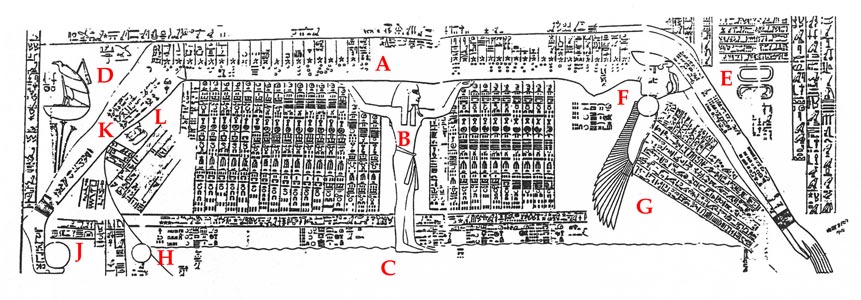
         In 1914, by an entry of thieves, Naville penetrated in a room of the Osireion, so-called room of the sarcophagus: On the ceiling, he discovered an immense representation of the sky with the body of the Nut goddess and explanatory texts (Traunecker, 2001).

         This scene will be called the Book of Nut, that one will recover later the ceiling of the sepulchral room of Ramsès IV. It would have been drawn under Merenptah. Another part of the ceiling is covered with a part of the Book of the Night (until the 9th hour) inscribed under Sety I (Hornung, 2007).
         For the Book of Nut on the ceiling of Ramsès IV, to see the site of the Theban Mapping Project, cf. page links).
         The body of Nut (A) spreads from east to west, sustained by the god Shu (B). The Geb god (the earth C) is not represented. In the evening, the sun is swallowed by the goddess (F) and follows a given way (described in G). At the dawn, the sun (H) is below the horizon. Then the sun appears (J) and it goes up (K). The newborn sun is under the shape of a winged scarab (kheper L)). It is the visible world in which moves the sun. The Nekhbet goddess, protector of the south, is drawn at the left (D).
         This ceiling also consists of a description of the external world (E) : "The faraway region of the sky is dived in the obscurity, one doesn't know its limits... this country is unknown of the gods (Traunecker, 2005)." So the visible world is an illuminated bubble surrounded by a cold and sink set, that surrounds it of all parts.
         This drawing has been duplicated from the book of M. Clagget (1995), according to Frankfort (The cenotaph of Seti I at Abydos, London-1933). The letters are from Traunecker (2005) and have been added by me on the drawing.
~data from Book of Nut
(繼續閱讀...)
文章標籤

s8626460 發表在 痞客邦 留言(0) 人氣(44)

  • 個人分類:Egypt
▲top
  • 5月 30 週日 201016:48
  • Book of Caverns

         The Book of Caverns is an important Ancient Egyptian funerary text of the Ancient Egyptian New Kingdom. 

         Like many funerary texts, it was written on the inside of the tomb for reference by the deceased. It describes the journey of the sun god Ra through the six caverns of the underworld, focusing on the rewards and punishments in afterlife.
         The earliest appearance of this work is in the left hand wall of the Osireion in Abydos. It first appears in the Valley of the Kings, in the tomb of Ramesses IV, in place of Amduat, where it was recorded by Champollion in his letters for Egypt.
         The book has no ancient title, and is not divided in the hours of the night as other Ancient Egyptian funerary texts are.
         The Book of Caverns originated in the Ramessid Period. The book is known to be an underworld book that speaks of the deceased who fail their judgment in the afterlife, and also the rewards of those who pass the judgments. The Book of Caverns is one of the best sources to date that gives us the best view of the Egyptian concept of Hell. The Book of Caverns is divided into two halves, six sections, by the ram headed sun god, and each half is divided into three other parts. The first half explains how the sun god invokes beings and groups of gods. The other half is a descriptive text of the earlier books. The Book of Caverns is much more literary that other funerary books, such as The Book of Gates, from the New Kingdom. The books does not have as many pictures than the other books, but instead it is much more descriptive and lengthy. The book describes the journey and tasks Re must go through to eventually end up in the Light. Re, the ram headed sun god, must take souls through the after life journey through many caverns guarded by gods and goddesses. Each cavern has its own task and if the soul does not pass then is it sent to nonexistence. If the soul is condemned to nonexistence then they are beheaded and their hearts are ripped out of their chests.
Contents
Section 1
         Section 1 of the book describes Re as the ram headed sun god and his mission is to enter the darkness in order to defend and care for Osiris. Then Re has to direct the entities; here the snakes of the first cavern guard the cavern entrance. Re must greet Osiris with his hand extended to him; Osiris is sitting on his shrine surrounded by the serpents. Osiris’s enemies are below him beheaded; this is the Egyptian concept of Hell, where the entities of humans go if they belong there. Osiris and Re then condemn them all to nonexistence.
Section 2
         In Section 2 Re must reach various gods and goddesses who are guarded by various serpents. Then once he reaches Osiris they souls are once again sent to nonexistence. Nonexistence is known as the Place of Annihilation where the souls are punished by guards with knives.
Section 3 through 6
         Section 3 through Section 6 is about the damned and their punishment. The damned are shown on ovals in the walls of the caverns, hence the book is called The Book of Caverns. In the caverns the gods lay also making sure each and every soul continues to serve their punishment. For the first time ever the book talks about women being in nonexistence. In all other books dealing with the afterlife of souls, none state anything about women in hell. Women were always thought to have been pure, and could never have the option of being damned to hell.
         As all the souls are trapped for eternity in hell, Osiris is down there with him. However a sun disc protects him and serpents surround him. Since he is protected he is able to continue the process. Osiris has two sons named Anubis and Horus. Anubis is a god with the head of a jackal he is the god of mummification and the path of the dead. Horus is the falcon headed god who is in charge of the living Pharaoh and also law, war, young men, and light.
Ramessid Period
         The Ramessid Period took place during 1295-1069BC (19th and 20th Dynasty), which is still part of the New Kingdom age. Pharaoh Rameses II is known for its length due to his many construction projects and confrontation with the Hittite Empire. During the 19th Dynasty Egypt’s power was threatened by the Hittite Empire from Syria aka Palestine and then later by the Libyan tribes, known as the “Sea People”. However in the 20th Dynasty it was a time of social unrest, due to the extremely powerful High Priests of Amun.
Origination
         The first known almost complete version of The Book of Caverns that only has its upper register damaged was located in the Osireion. The Osireion was built at a considerably lower level than the foundations of temple Seti. It was first discovered by archaeologists Flinders Petrie and Margaret Murray who were excavating the site in 1902 through 1903. The Osireion was built with enormous 60-ton granite columns and is made up with a very different architectural style than to Seti’s temple being more like the Old Kingdom temples. The Book of Caverns was found directly across from the Book of Gates within the entrance passage on the left wall. The Book of Gates was located near the Book of Caverns because it also deals with death. The Book of Gates is an Ancient Egyptian sacred text that dates back to the New Kingdom Dynasty also. The book is about the journey of the deceased soul into the next world. The soul passes through a variety of ‘gates’ during different stages in their journey. If a soul does not make it through a gate it will suffer torment in the lake of fire, but if it makes it through them all it will pass unharmed. Both of the books are based upon funerary text of the New Kingdom, however they did not show up until the 19th Dynasty and were not in any of the tombs within the Valley of the Kings however except for Pharaoh Ramesses IV.
         Ramesses IV was the first to use one of the earliest passages from the Book of Caverns, rather than the traditional Amduat passages. Ramesses VI was the first to use the entire version of the book in his tomb, in the Osireion, with the Book of Gates in the front of the tomb. The passages of the book were written all over the walls of the tomb completely covering it in text. Ramesses VII went even further and had passages not only written on the walls but the ceilings also, and in the sarcophagus chamber. Ramesses VII was the first to ever have a completed covered tomb in every room with The Book of Caverns. After his tomb, Ramesses VII, every future tomb to be created had used The Book of Caverns completely also.
History
         Jean Francios Champollion first wrote about the book from the tomb of Ramesses VI providing some translations. Scholars however were not interested in the book at the time, until about a century later, when the second complete version of the book was discovered in the Osireion. In 1933 Henri Frankfort tired to write the first complete translation of the book with the help of Adriaan de Buck. Unfortunately it was not translated completely into English until 1941. He also translated the text in the tomb of Ramesses VI in 1954.
~ data from Wiki
(繼續閱讀...)
文章標籤

s8626460 發表在 痞客邦 留言(0) 人氣(61)

  • 個人分類:Egypt
▲top
  • 5月 29 週六 201023:42
  • KV2

         KV2位於埃及帝王谷,是古埃及第二十王朝法老拉美西斯四世的陵墓,在古代已經被打開。
         陵墓內的雕刻幾乎完整無缺,刻有的銘文包括有《拉之連禱》、《洞穴之書》、《死亡之書》、《陰間書》、《天堂之書》及《地獄之書》。
         墓室內的石棺在古時已經破爛,而拉美西斯四世的木乃伊後來於KV35發現,目前藏於開羅的埃及博物館。
建築特色
         拉美西斯四世在位時,埃及國力衰弱,所以KV2的設計簡單。整個陵墓筆直而輕微向下傾斜,入口有兩個樓梯通往地下通道,而該通道可分為三段,經過三段的走廊後便到達前廳,前廳之後是墓室,而墓室的後面是幾間小室。
         在第一及第二段通道中繪有《拉之連禱》的文字以及法老崇拜拉的情形,而在天花板上則刻有張開翅膀的禿鷹、隼及聖甲蟲。在第三段通道中可找到《洞穴之書》的第一和第二部分,而這兩段通道的天花板畫滿了星星;前廳則刻有《死亡之書》的內容,大部分的內容來自第125章,關於法老死後在冥界接受眾神的審判。
         經過前廳後就會到達墓室,亦即是放置法老石棺的地方,雖然整個墓室的面積並不是很大,但是石棺卻異常的大。墓室內繪有《地獄之書》的第二、三、四節(《地獄之書》分為十二節,代表靈魂進入新世界,對應與太陽在夜晚穿過地底世界的旅程)。墓室的天花板裝飾較為特別,一般墓室的天花板通常以星星圖案作為裝飾,但在KV2卻描畫天空女神努特。墓室內亦可看到《天堂之書》,而墓室後的小室則刻有《洞穴之書》第一部分的文字,其他小室則繪有祭品,如床、神龕及卡諾匹斯罐(又作坎努帕斯罐)。
平面圖
         KV2是帝王谷裏少數留下古代平面圖的陵墓,其中一幅繪於紙莎草上的平面草圖最為有名和完整,目前存放於都靈的埃及博物館。另一幅則刻於一塊陶器瓦片上,描繪外部門廊的細節,由艾爾頓於陵墓入口的瓦礫中發現。二者均顯示陵墓已經完工:紙莎草的平面圖顯示完成的陵墓比原本的設計簡略,而陶器瓦片則展示陵墓的門是閂上的。
背景歷史
         KV2亦成為早期帝王谷探險家,如商博良等棲身的地方,不單是現代的探險家,古時亞歷山大科普特正教會的教徒也經常來到墓穴中,現在陵墓中也可看見他們以科普特文及希臘文繪畫的塗鴉。
保護情況
         KV2並無受到河水氾濫的損害,而陵墓內牆上的圖案亦保存良好。
         埃及古物協會(Egyptian Antiquities Association)與埃及古物最高委員會(Supreme Council of Antiquities)目前負責填補墓內牆壁及天花板的裂縫及破洞、並清潔墓內的繪圖裝飾、設置燈光設備、木製通道及玻璃板。
~data from Wiki
(繼續閱讀...)
文章標籤

s8626460 發表在 痞客邦 留言(0) 人氣(58)

  • 個人分類:Egypt
▲top
  • 5月 23 週日 201021:57
  • Nefertem

         In Egyptian mythology, Nefertem (perhaps to be translated: 'the beautiful one who closes' or 'the one who does not close'; also read as Nefertum, Nefer-Tem, Nefer-Temu) was originally a lotusflower at the creation of the world, who had arisen from the primal waters, in the Ennead cosmogeny.

         Nefertum represented both the first sunlight (also often associated with the shapes of a lion or a falcon god; sunlight was also supposed to shine forth from the double high feathers from the deity's head, a usual aspect of his iconography) and the delightful smell of the Egyptian blue lotusflower having arisen from the primal waters within an Egyptian blue water-lily, Nymphaea caerulea, (This flower is widely used in Egyptian art, religion and literature. In much of the literature about ancient Egypt, it is called the "(blue) lotus". However, the true lotus, Nelumbo nucifera, is not found in Egypt until the time of the Persian invasion, when it was introduced as a food crop.) Some of the titles of Nefertem were "He Who is Beautiful" and "Water-Lily of the Sun", and a version of the Book of the Dead says, "Rise like Nefertem from the blue water lily, to the nostrils of Ra (the creator and sungod), and come forth upon the horizon each day." As the power of Memphis grew, their chief god, Ptah, was said to be the original creator, and thus of all the other gods, including any lesser creators, who create the remaining gods having first being created by Ptah. Consequently Nefertum came to be merely the son of Ptah, rather than a creator of light proper. As son of Ptah, it was said that either the lioness-deities Sekhmet, or Bast (whichever was considered wife of Ptah), was his 'mother'. As a god now only associated with the highly aromatic blue water-lily rather than creation, he became a god of perfume and luck. In art, Nefertum is usually depicted as a beautiful young man having blue water-lily flowers around his head. As the son of Bast, he also sometimes has the head of a lion or is a lion or cat reclining. Nefertem was associated both with the scent of the blue water-lily flower and its supposed narcotic effect (widely presumed, but yet untested scientifically). The ancient Egyptians often carried small statuettes of him as good-luck charms.

Alt
the Memphite god Nefertem with a water-lily heardress as a symbol of fragrance and beauty.


God of healing and beauty


Major cult center
Memphis


Symbol
the water-lily


Parents
Ptah and Sekhmet


Siblings
Maahes (in some accounts)

(繼續閱讀...)
文章標籤

s8626460 發表在 痞客邦 留言(0) 人氣(47)

  • 個人分類:Egypt
▲top
  • 5月 23 週日 201021:53
  • Khnum

Alt
         In Egyptian mythology, Khnum (also spelled Chnum, Knum, or Khnemu) was one of the earliest Egyptian deities, originally the god of the source of the Nile River.

         Since the annual flooding of the Nile brought with it silt and clay, and its water brought life to its surroundings, he was thought to be the creator of the bodies of human children, which he made at a potter's wheel, from clay, and placed in their mothers' wombs. He later was described as having molded the other deities, and he had the titles Divine Potter and Lord of created things from himself.
         In certain locations, such as Elephantine, since Khnum was thought of as a god pouring out the Nile, he was regarded as the husband of Satis (who did much the same), and the father of Anuket, who was the personification of the Nile. In other locations, such as Her-wer (Tuna el-Gebel perhaps), as the moulder and creator of the human body, he was sometimes regarded as the consort of Heket, or of Meskhenet, whose responsibility was breathing life into children at the moment of birth, as the Ka. Alternatively, in places such as Esna, due to his aspect as creator of the body, they viewed him as the father of Heka, the personification of magic, and consequently as the husband of Menhit.
         Originally one of the most important deities, when other areas arose to greater prominence, it was the secondary function, as potter, that became his whole realm of authority, and instead, the Nile was considered the god Hapy, who was the Nile god in the more powerful areas. Khnum's name derives from this secondary association, – it means builder. However, Khnum's earlier position as 'moulder' of the other deities, leads to him being identified as Ra, or more particularly as the Ba of Ra. Since Ba was also the word for a Ram, he became thought of as having a Ram's head, but he really has a bull's head.
         In art, he was usually depicted as a bull-headed man at a potter's wheel, with recently created children's bodies standing on the wheel, although he also appeared in his earlier guise as a water-god, holding a jar from which flowed a stream of water. However, he occasionally appeared in a compound image, depicting the elements, in which he, representing water, was shown as one of four heads of a man, with the others being, – Geb representing earth, Shu representing the air, and Osiris representing death. Some think this is a depiction which may have had an influence on Ezekiel and Revelations, as Khnum had a Ram's head, Shu sometimes appeared with a Lion's head, Osiris was a human, and Geb had a goose on his head.
         The worship of Khnum centred on two principal riverside sites, Elephantine Island and Esna, which were regarded as sacred sites. At Elephantine, he was worshipped alongside Anuket and Satis as the guardian of the source of the River Nile. His significance led to early theophoric names of him, for children, such as Khnum-khufwy – Khnum is my Protector, the full name of Khufu, builder of the Great Pyramid. Due to his importance, as an aspect of the life-giving Nile, and also the creator, Khnum was still worshipped in some semi-Christian sects in the second or third centuries.
         Khnum has also been related to Min (god).
(繼續閱讀...)
文章標籤

s8626460 發表在 痞客邦 留言(0) 人氣(36)

  • 個人分類:Egypt
▲top
  • 5月 23 週日 201021:45
  • Khepri

Alt
         In Egyptian mythology, Khepri (also spelled Khepera, Kheper, Chepri, Khepra) is the name of a major god.

         Khepri is associated with the dung beetle (kheper), whose behavior of maintaining spherical balls of dung represents the forces which move the sun. Khepri gradually came to be considered as an embodiment of the sun itself, and therefore was a solar deity. To explain where the sun goes at night, such pushing was extended to the underworld, Khepri's pushing of the sun being ceaseless.
         Since the scarab beetle lays its eggs in the bodies of various dead animals, including other scarabs, and in dung, from which they emerge having been born, the ancient Egyptians believed that scarab beetles were created from dead matter. Because of this, they also associated the Khepri with rebirth, renewal, and resurrection. Indeed, his name means "to come into being". As a result of this, when the rival cult of the sun-god Ra gained significance, Khepri was identified as the aspect of Ra which constitutes only the dawning sun (i.e the sun when it comes into being).
         Subsequently, when Ra and Atum became identified as one another, Khepri, which was Ra's young form, became conflated with Nefertum, which was Atum's. This led to a cosmogony where Ra, as Khepri, a beetle, resulted from the Ogdoad's activities, and emerged from a (blue) lotus flower, only to immediately transform into Nefertum, a youth, who, after growing up, masturbated the Ennead into existence.
         Khepri was principally depicted as a whole scarab beetle, though in some tomb paintings and funerary papyri he is represented as a human male with a scarab as a head. He is also depicted as a scarab in a solar barque held aloft by Nun. When represented as a scarab beetle, he was typically depicted pushing the sun across the sky every day, as well as rolling it safely through the Egyptian underworld every night. As an aspect of Ra, he is particularly prevalent in the funerary literature of the New Kingdom, when many Ramesside tombs in the Valley of the Kings were decorated with depictions of Ra as a sun-disc, containing images of Khepri, the dawning sun, and Atum, the setting sun.
Scarab, "Kheper" as transformation
         The scarab, Egyptian language (kh)pr is used in many pharaonic names, for example Thutmosis III as Mn-Kheper-Re. Because it is used so frequently in pharaonic names, for example:
         Kheperkare Senusret I, Khakheperre Senusret II, Aakheperkare Thutmose I, Aakheperenre Thutmose II, Menkheperre Thutmose III, Aakheperrure Amenhotep II, Menkheperrure Thutmose IV, etc.
         its meaning needs to be presented. As the word "transform", or "transformation", the phrase Men-(Kh)eper-Re becomes: strong-transforming-Ra, and some renderings in common English are The Transforming Strength (of) Ra, or Ra's Steadfastness (of) Transformations. A much later word that replaced the kheper, 'transforming' was the Greek language "epiphanous", the word for manifesting. A similar usage, but not with the implications of transformation, as an insect larva, transforming into an adult-form bug. The Ptolemaic era Ptolemy V of the Rosetta Stone, 196 BC is named Ptolemy V Epiphanes. Coins of Greece and other Greek influenced kingdoms had coins using the King's profile and the word epi(ph)anous, namely basileus epi(ph)anous, (King-Manifested).
(繼續閱讀...)
文章標籤

s8626460 發表在 痞客邦 留言(0) 人氣(68)

  • 個人分類:Egypt
▲top
  • 5月 23 週日 201020:15
  • The Souls of Pe and Nekhen


         The Souls of Pe and Nekhen, mentioned first in the Pyramid Texts, refer to the ancestors of the ancient Egyptian kings.

         Nekhen (Greek Hierakonpolis) was the Upper Egyptian centre of Horus worship, whose successors the Egyptian pharaohs were thought to be. Pe (Greek Buto) was a Lower Egyptian town, not known for its Horus worship, but Re had awarded the town to Horus after his eye was injured in the struggle for the throne of Egypt.
         The approbation of their predecessors, even as mythological and nameless as the Souls of Pe and Nekhen, was important to the Egyptian kings, who referred to them in many inscriptions. Even the Kushite pharaohs saw themselves as descendants of the Souls of Pe and Nekhen.
         It appears that the Souls of Heliopolis comprised the Souls of Pe and Nekhen.
(繼續閱讀...)
文章標籤

s8626460 發表在 痞客邦 留言(0) 人氣(37)

  • 個人分類:Egypt
▲top
12...12»

留言板

餘音繞樑

我去誰家

走訪國家

GoogleAdsense

著作分類

toggle 健力重訓 (17)
  • 硬舉 (15)
  • 臥推 (13)
  • 深蹲 (13)
  • 課表 (30)
  • 飲食 (18)
  • 呼吸 (4)
  • 暖身 (6)
  • 伸展 (3)
  • 傷痛 (8)
  • 胸肌 (5)
  • 三角肌 (3)
  • 闊背肌 (4)
  • 腹肌 (6)
  • 臀肌 (1)
  • 股四頭肌 (1)
  • 腿後肌 (1)
  • 握力 (2)
toggle 雪泥鴻爪 (23)
  • 2019 俄羅斯 Russian Federation (24)
  • 2018 英國 United Kingdom of Great Britain and Northern Ireland (23)
  • 2018 法國 France (31)
  • 2017 土耳其 Turkey (68)
  • 2016 教廷 Holy See (0)
  • 2016 義大利 Italy (11)
  • 2016 美國 United States of America (33)
  • 2015 中國 People's Republic of China (31)
  • 2014 越南 Viet Nam (33)
  • 2013 印度 India (60)
  • 2012 日本 Japan (30)
  • 2011 澳門香港 Macau Hong Kong (55)
  • 2011 日本 Japan (32)
  • 2009 埃及 Egypt (62)
  • 2007 柬埔寨 Cambodia (11)
  • 2007 馬來西亞 Malaysia (7)
  • 台灣北部 Northern Taiwan (119)
  • 台灣中部 Central Taiwan (27)
  • 台灣東部 Eastern Taiwan (16)
  • 台灣南部 Southern Taiwan (39)
  • 台灣離島 Taiwan's Offshore Island (17)
  • 台灣百岳 Taiwan's Top 100 (10)
  • 台灣台南 Taiwan Tainan (76)
toggle 世界遺產 (10)
  • Egypt (112)
  • Shirakawa-go (35)
  • World Heritage (5)
  • Angkor (28)
  • Macau (33)
  • India (48)
  • Kinabalu Park (6)
  • San Antonio (25)
  • Viet Nam (27)
  • Jiuzhaigou (22)
toggle 尋幽訪勝 (2)
  • Hong Kong (18)
  • Hokkaido (24)
toggle 紙醉金迷 (24)
  • ARMANI (7)
  • GIVENCHY (0)
  • 晶礦沉香 (3)
  • dyson (1)
  • 酒 (107)
  • DIESEL (1)
  • LEVI'S (1)
  • VERSACE (3)
  • PRADA (3)
  • BOTTEGA VENETA (1)
  • TOD'S (1)
  • SAINT LAURENT (2)
  • LOEWE (1)
  • DOLCE & GABBANA (2)
  • Paul Smith (1)
  • 武陵 (14)
  • Koto (1)
  • 金富成 (1)
  • BURBERRY (8)
  • HUGO BOSS (2)
  • Audi (132)
  • COACH (3)
  • LOUIS VUITTON (1)
  • GUCCI (4)
toggle 黃樑一夢 (13)
  • 2025年投資 (31)
  • 2024年投資 (52)
  • 2022年投資 (22)
  • 2021年投資 (87)
  • 2020年投資 (4)
  • 2013年投資 (3)
  • 2012年投資 (3)
  • 2011年投資 (5)
  • 2010年投資 (10)
  • 2009年投資 (14)
  • 2008年投資 (4)
  • 2007年投資 (4)
  • 片言隻字 (46)
toggle 相思呢喃 (5)
  • 呢喃 (100)
  • 羹湯 (1)
  • 心語 (57)
  • 相思 (14)
  • 手札 (15)
toggle 婚禮人像 (4)
  • 車展 (3)
  • 婚禮 (13)
  • 人像 (21)
  • 水墨 (3)
  • 未分類文章 (1)

記事彙整

文章搜尋

近期隨筆

  • Breaking the Copper Wall
  • Income statement structure
  • DOLLAR TO PESO FORECAST
  • 2025 Draft List of Critical Minerals
  • The drug companies recently have announced investments in new U.S. facilities
  • Rare Earth Elements
  • The worst performing stocks in the S&P 500 this year
  • The competitors in software industry
  • The competitors in interactive media and services industry
  • CorMedix - the anti-infective space

熱門手札

  • (946)帝王谷‧KV6
  • (1,164)Golden Eagle Perfume Palace
  • (1,910)金富成項鍊
  • (959)新千歳空港
  • (136)DIESEL ZATINY 0882V
  • (612)國人訪印度參考資料
  • (3,130)四埔吳
  • (993)泰姬瑪哈陵(下)
  • (1,311)天馬EXTRA白蘭地
  • (2,047)天馬金牌X.O白蘭地

參觀人氣

  • 本日人氣:
  • 累積人氣:

訪客地圖

訪客旗幟

誰來我家